
FiberLens is a strategy and investment intelligence platform purpose-built for the U.S. fiber industry. It works two ways. You can start with a market, selecting a county and reading its broadband economics before any provider is in the picture, or you can start with an operator and work through its footprint, growth options, acquisition targets and exit. We built it for private equity and infrastructure investors, strategic acquirers, and fiber operators who face these decisions repeatedly, across individual assets and across whole portfolios.
Why the U.S. fiber market needs FiberLens
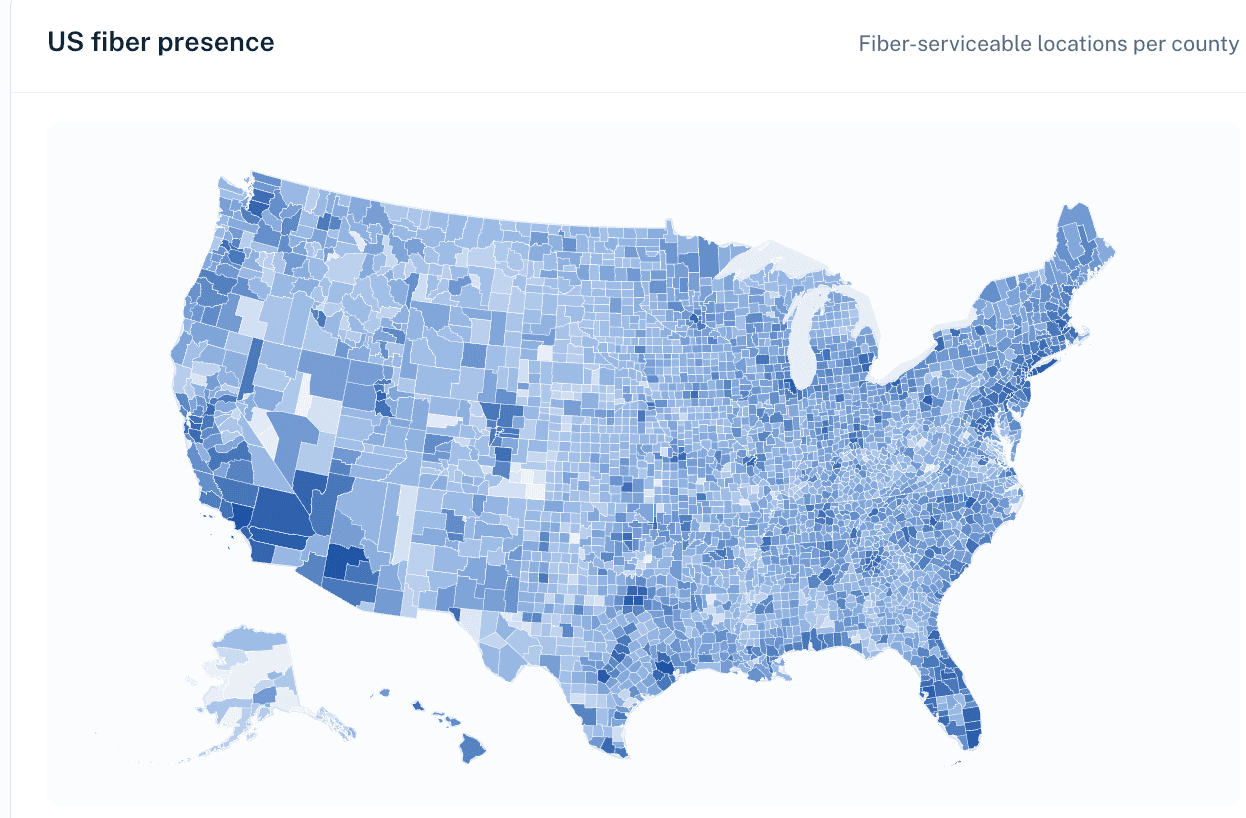
The U.S. fiber market has shifted from building reach to earning returns. Fiber now passes more than 60 percent of U.S. homes, according to Fiber Broadband Association data, and the remaining locations are the harder, costlier ones to reach. The land-grab phase is largely over; the question now is what these networks earn.
Capital is already responding. With higher borrowing costs and most BEAD-funded construction still ahead, about two thirds of operators are slowing or stopping new builds. Returns now depend on how many passed homes subscribe, how well a network holds up against fixed wireless and cable, and what it costs to serve, and all three vary market by market.
The same math is driving consolidation. Roughly 1,500 operators serve close to 69 million fiber locations, and about 83 percent serve fewer than 25,000 each. Their footprints barely overlap, so around 97 percent of locations an acquirer picks up are net-new coverage. Footprint fit, not target size, determines deal value. The AlixPartners U.S. Fiber Consolidation Sentiment Index finds about 95 percent of expected M&A involves operators below 500,000 passings, and 73 percent of operators expect a deal within the next year.
That leaves sharper questions. Which passed homes can be converted, and how fast? Which markets are about to lose subscribers to fixed wireless or cable? Where does the next build dollar earn a return? Which operator's footprint truly fits yours, and what is the combined network worth? These are footprint-level questions, and answering them is exactly what FiberLens is built to do.
What is FiberLens?
FiberLens sits on a single footprint data spine built from public sources, including FCC broadband data and the 2025 TIGER Census. Everything is resolved down to the individual serviceable location.
On that base FiberLens offers two ways into a question. Market Intelligence starts from a geography and reads a broadband market on its own terms. Provider Intelligence starts from a company and works through the decisions an operator or its owner actually has to make. Both draw on the same underlying data, which means the market view and the company view stay consistent with each other instead of being assembled separately.
Start with an operator: Provider Intelligence
Provider Intelligence begins with a company. You load an operator's reported footprint and work through six layers, each answering a different decision, all reading off the same location data.
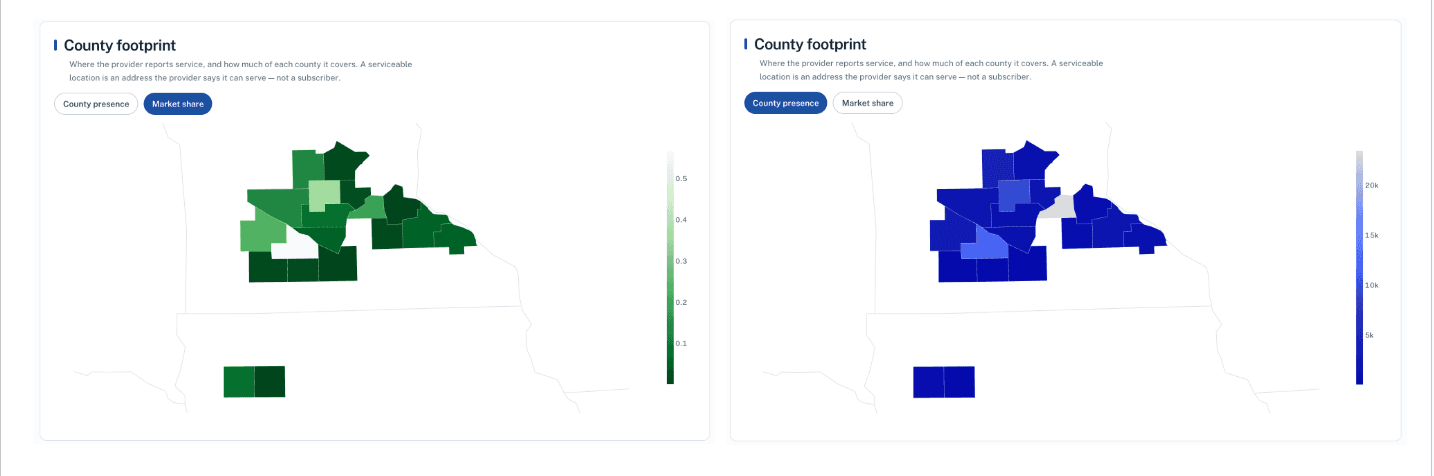
Provider Assessment starts from the operator's most recent FCC availability filing and lays out the footprint: how many broadband serviceable locations it reports, across how many states, counties and census tracts, the fastest speeds it advertises anywhere, and how those locations split by access technology and speed tier. A serviceable location is an address the operator says it can serve. It is not a subscriber or an active connection, and the assessment keeps that distinction in view throughout.
County by county, it then shows how much of the reported coverage belongs to this operator and how concentrated the local market is. Concentration is measured with the Herfindahl-Hirschman Index across every provider in the county. Dominance is the portion of that concentration the operator accounts for on its own, and it only reaches its maximum where the operator is the sole reported provider. That dominance figure is the position measure Growth Strategy uses next. Alongside it sit Census figures for each county, including median income and a socioeconomic score, plus a comparison of the whole footprint against U.S. benchmarks for income, broadband subscription, housing occupancy and scale. The result reads as strengths and constraints side by side, so a footprint concentrated in a few strong counties registers as an efficiency and as a dependence at the same time.
Growth Strategy places every county the operator serves on two measures. One is position, meaning how much of the county's overall market concentration belongs to this provider. The other is market quality, taken from the county's socioeconomic score. Each measure is split at the median of the provider's own counties, which produces four postures. A strong position in an attractive market is Build, a weak position in an attractive market is Buy, a strong position in a weaker market is Optimise, and a weak position in a weaker market is Prune.
Because the cut-offs come from the provider's own footprint, roughly a quarter of its counties land in each posture by design. The split shows how the operator's markets compare with one another and makes no claim about where they sit nationally.
Those county calls then roll up into a portfolio view: how many markets sit in each posture, how many locations the operator already serves there, and how much unserved opportunity each group holds. The comparison worth looking at first is Build against Buy. When most of the addressable opportunity sits in Build markets, the operator can plausibly reach it organically. When it sits in Buy markets, the position is too weak to build into, and the growth plan starts to look like an acquisition plan.
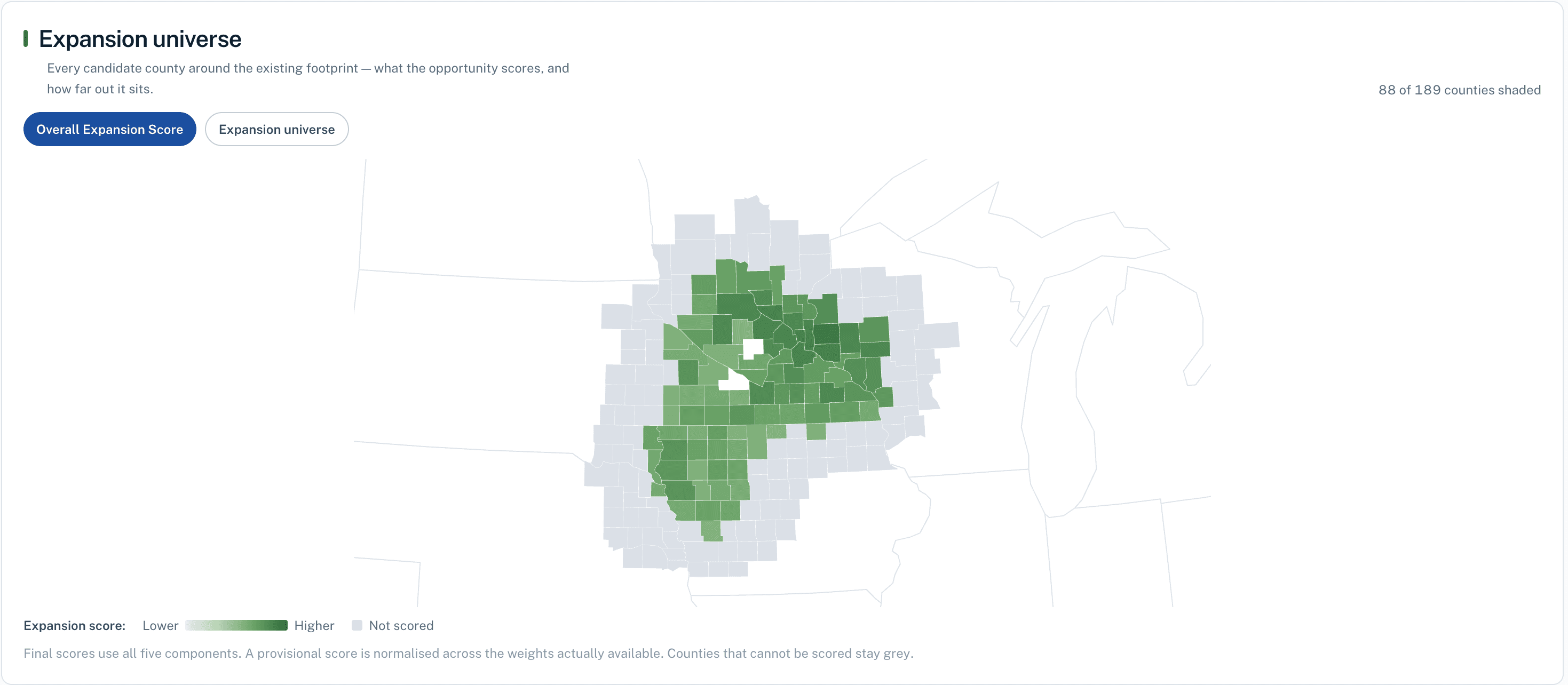
Organic Growth looks outward from the current footprint to the counties an operator could reasonably reach, and ranks them on the factors that decide whether a build pays off: housing-unit scale, contiguity to the existing network, competition, and how likely the incumbent telco is to upgrade copper to fiber. The output is a candidate universe and a ranked build list, grouped into plays that share a route or corridor, rather than a single headline number.
Inorganic Target Identification builds the acquisition universe. It assembles the operators in and around a market, resolves who owns them, and screens and ranks them relative to a specific buyer rather than in the abstract, so the list reflects which targets would actually strengthen this platform.
Acquisition and Synergy takes a target that is in play and rebuilds buyer and target as a single combined network. It quantifies the overlap, the incremental reach a combination adds, and the commercial, network and cost synergies it would or would not deliver, so the strategic case and the economics of a deal sit in one place.
Exit Positioning works backward from the sale. Fiber platforms are generally built to be sold, and at the top end the buyer universe is small and specific. This layer defines the target end-state, the growth runway still left, the realistic set of buyers, and the milestones that make an asset exit-ready, so exit becomes something an operator plans toward from the start rather than discovers at the end.
Start with a market: Market Intelligence
Market Intelligence begins with geography rather than a company. You choose a state and a county, and FiberLens reads the broadband market there without any management data and without first selecting a provider. That independence is the whole point. An investor can judge a market on its own merits before anyone's projections enter the room.
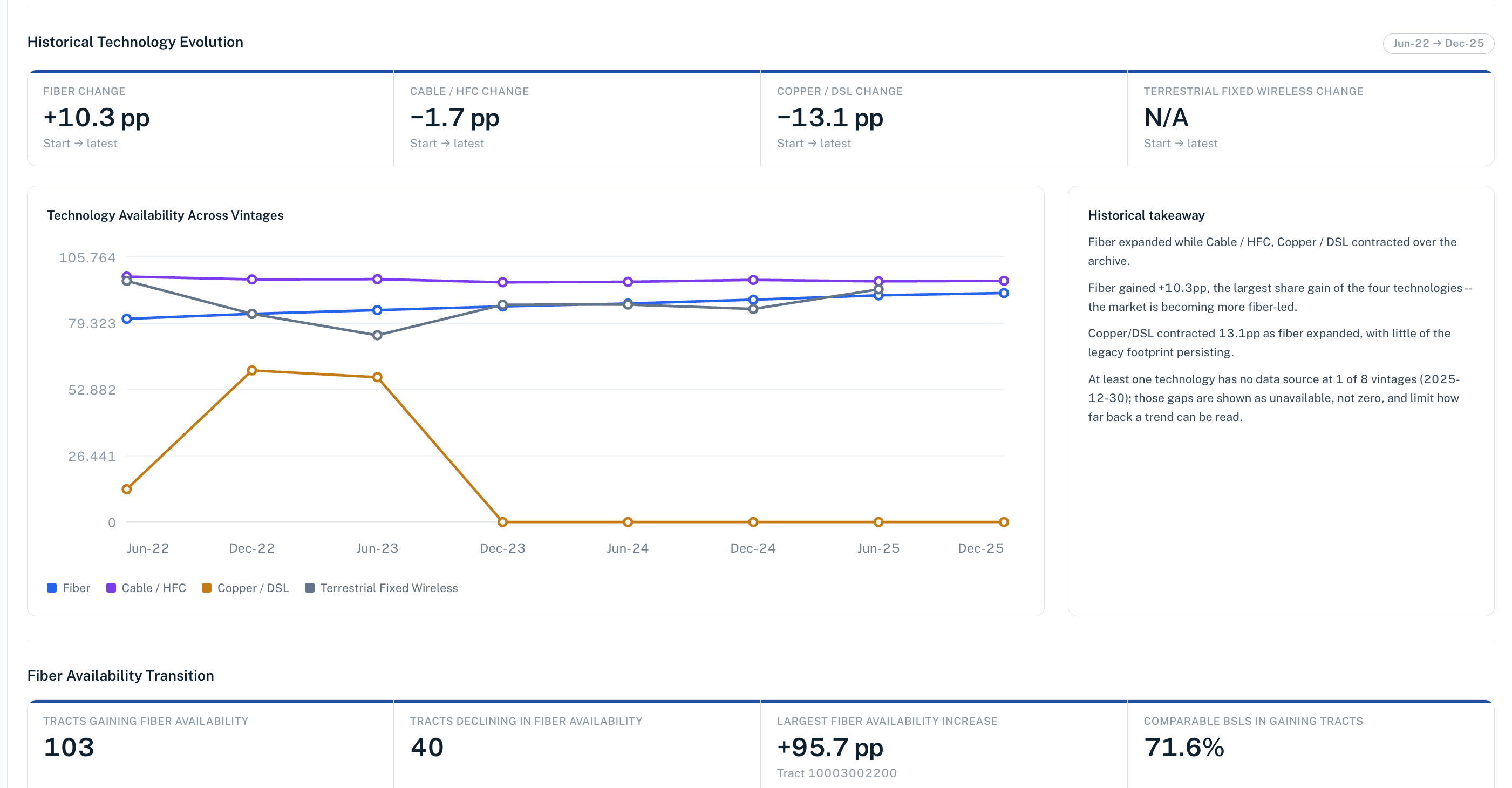
It works through four questions in order. What kind of market is this, in size, demand and socioeconomic profile. Who competes here, how strong they are, and how the market has been changing across successive FCC vintages. Where the real fiber and high-speed opportunity sits, separating genuine addressable whitespace from empty acreage that will never pay back. And what is likely to happen next: which deployments are already publicly committed, which operators are positioned to move in, and how durable the opportunity is once they do.
For a diligence team, the last question is often the one that matters most. Market Intelligence gives a read on a market that owes nothing to the seller's story, which is exactly what you want before you decide how much of a management plan to believe.
Who is FiberLens for?
FiberLens is for the people who make fiber capital decisions for a living. Private equity and infrastructure investors underwriting fiber platforms. Strategic acquirers assessing whether a target actually fits. Advisors running diligence who need a read on a market that is independent of management claims. The common thread is that these teams make the same set of decisions again and again, and they benefit from making them on a consistent analytical basis.
Frequently asked questions
What is FiberLens? FiberLens is a strategy and investment intelligence platform for the U.S. fiber industry. It lets investors and operators read a fiber market from a geography, or analyse a specific operator's footprint, growth options, acquisition targets and exit, all from a single footprint data spine.
What is the difference between Market Intelligence and Provider Intelligence? Market Intelligence starts with a geography. You pick a county and assess the broadband market there without selecting a provider or using management data. Provider Intelligence starts with a company and works through six layers: Provider Assessment, Growth Strategy, Organic Growth, Inorganic Target Identification, Acquisition and Synergy, and Exit Positioning.
What data does FiberLens use? FiberLens is built on public sources, including FCC broadband data and the 2025 TIGER Census. Analysis is resolved to the individual serviceable location.
Do I need management data to use FiberLens? No. Market Intelligence is designed to assess a market from public data alone, without a management plan, which is what makes it useful for independent diligence. Management data can sharpen a picture but is not required to start.
If you are underwriting fiber right now and any of the questions above sound familiar, book a walkthrough with our team and tell us how you are approaching them.