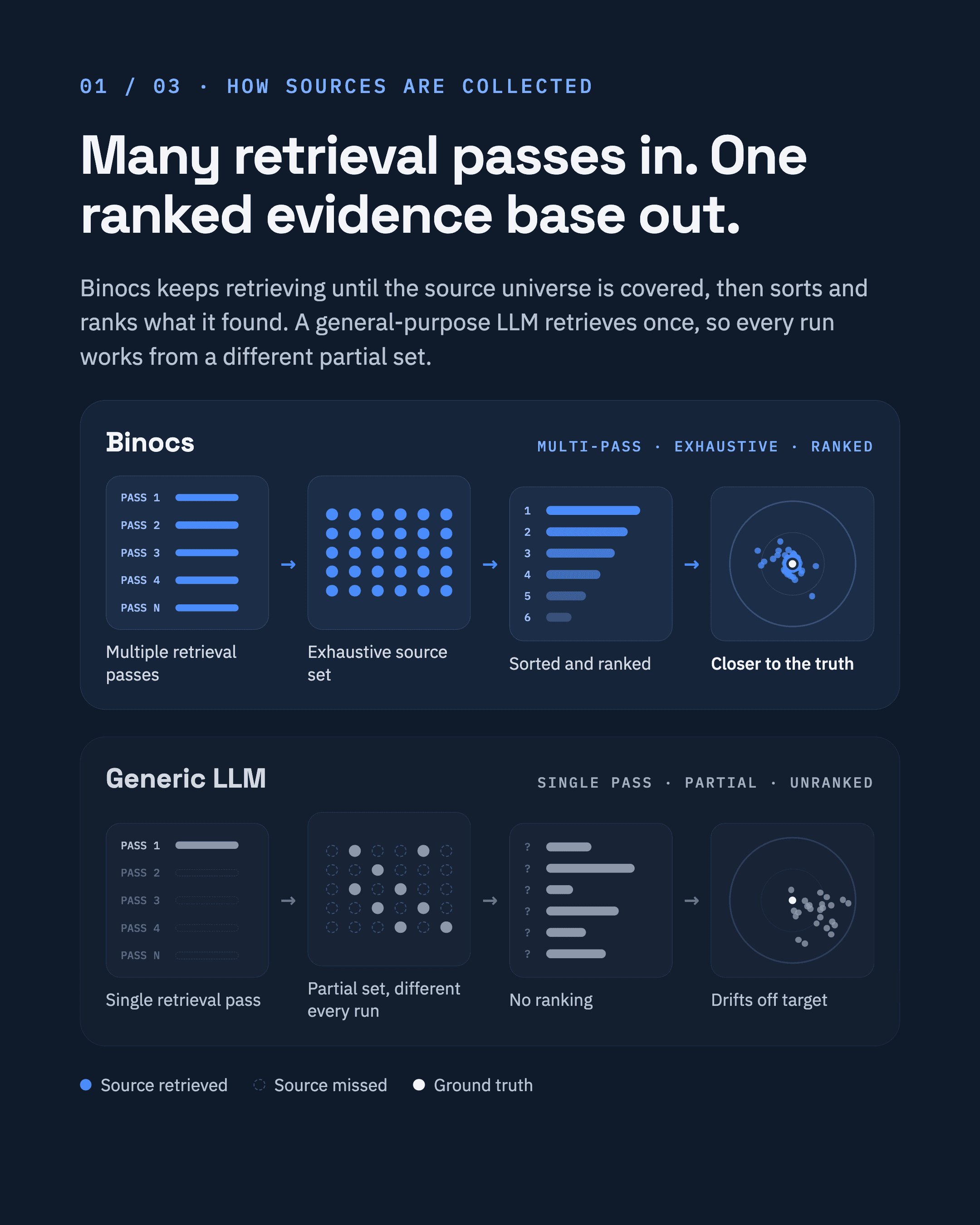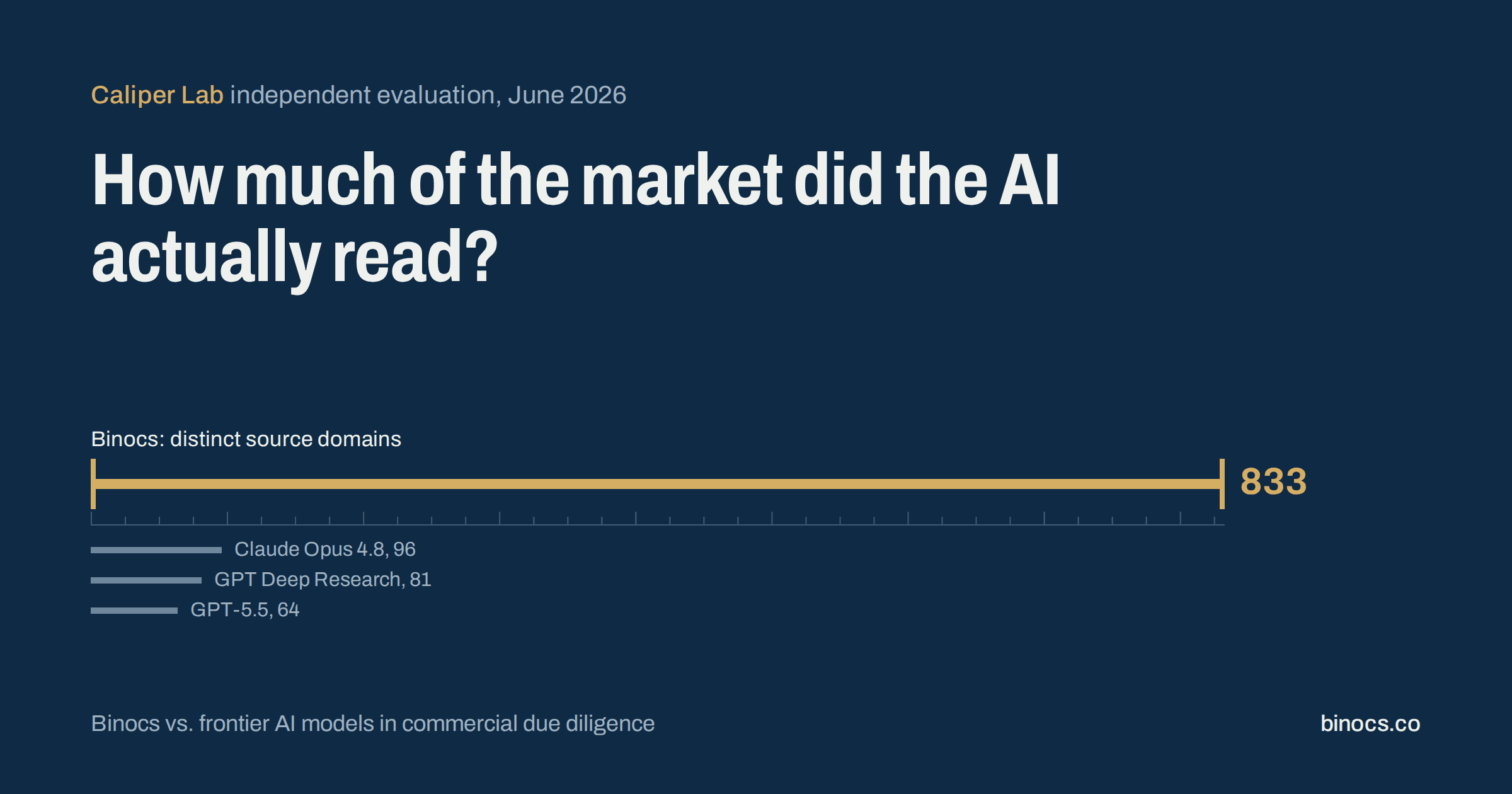

Most debates about AI in due diligence are about which model is smarter. But a model can only work with the sources it is given. If it misses a competitor, the market share numbers are wrong. If it relies on one biased report, the conclusion is biased too. If it never finds the data that disagrees, nobody knows to question the answer.
So at Binocs we built a dedicated evidence layer that runs before the AI writes anything. We call it Source Monte Carlo.
Where a single AI prompt falls short
Ask a general AI tool to research a company and it will run a few searches, take the top results, and write a confident answer. For diligence, that causes three problems:
- It searches narrowly. Search results favour popular pages and press releases. Smaller competitors, niche trade surveys and customer comments on earnings calls rarely show up, and those are often what changes the answer.
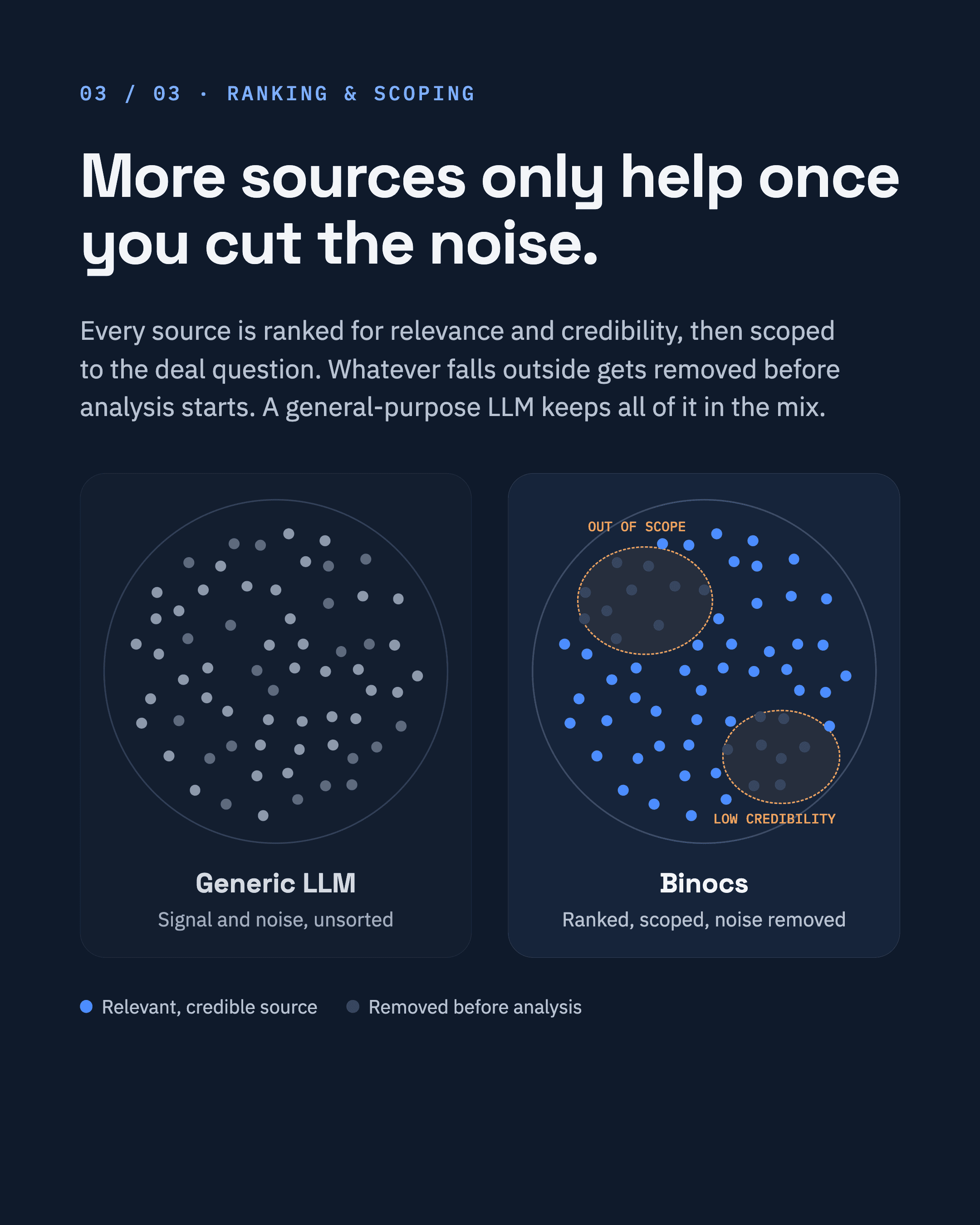
- It can't tell good sources from weak ones. An old blog post and a recent regulatory filing get roughly the same weight. Sometimes the source is invented altogether.
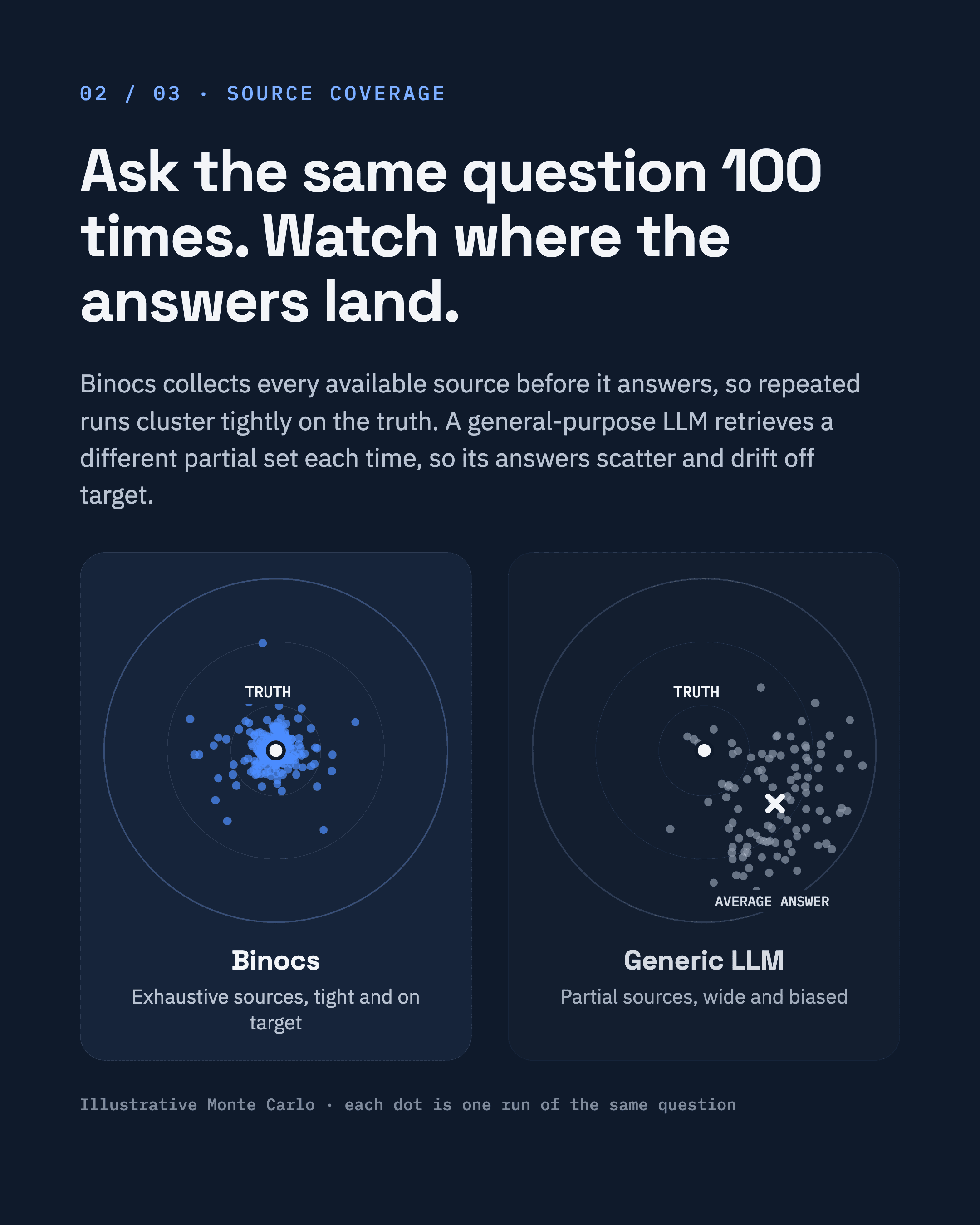
- It gives different answers each time. Run the same question twice and you get different sources, so different conclusions. That is hard to trust and harder to defend in front of an investment committee.
How Source Monte Carlo works
Binocs builds the evidence base first, the way an experienced analyst would if they had unlimited time. The AI only starts its analysis once that base is ready. It follows four steps:
- Discover. Search across public sources, proprietary databases, deal-room documents and alternative signals like podcasts and interviews.
- Expand. Look at what has been found, spot the gaps, and search again. A competitor mentioned once in a trade journal becomes a new search. This repeats until new searches stop adding anything useful.
- Rank. Score every source on relevance, credibility and recency. A recent government dataset beats a sponsored whitepaper from 2021.
- Triangulate. Check each claim against independent sources. Where sources disagree, the disagreement is flagged for the reader instead of being dropped.
Under the hood, several AI models and Binocs' own software run this in sequence. Early steps cast a wide net. Later steps group, count, rank and trim.
What this looks like inside four Binocs reports
Each report type has its own fixed rules for what to search, in what order, and what counts as proof.
Competitive Trends
- Every competitor is checked against the same factors: product, pricing, distribution, partnerships, legal and more.
- Only dated actions from the last 18 months count, with a cap of 3 per competitor per factor.
- A pattern only counts as a trend if at least 2 different companies show it.
- The report shows at most 6 trends. Weaker watch items appear only if there is space left.
Key Industry Trends
- The search covers 9 signal types, including interest rates, tariffs and regulation.
- A first draft of 8 to 10 trend cards has to cover 5 required areas.
- Every cited link is checked. If more than half are fake or missing, the draft is thrown out.
- A separate AI review cuts the final set to 5 to 7 cards, with at most two rounds of revision.
Competitor Discovery
- The industry is split into distinct markets first.
- Companies are found by what they do, not just by name, and each is tagged to its markets.
- Companies the user names always appear first.
- Each company is marked public or private, with its parent company shown.
Mergers and Acquisitions
- The search covers the last 24 months and widens to 36 if nothing turns up.
- Each deal is scored on 7 signals. The top 8 are grouped into themes that don't overlap.
| Step | Frontier LLM | Binocs |
|---|---|---|
| What to check | Whatever comes up first | A fixed checklist per report |
| Sources | May be invented | Links verified; mostly bad drafts rejected |
| Number of results | As many as it likes | Set ranges, e.g. 5 to 7 trends |
| Weak Results | Included | Dropped or marked lower priority |
| Disagreeing data | Often missed | Flagged for the reader |
- Key facts must come from filings. Figures that can't be confirmed are marked undisclosed, never estimated.
- Deal size is judged against its own industry. If no deals qualify, the section is left out.
What deal teams get
- Deeper insights. A wider search finds what a quick one misses: the smaller competitor gaining share in one region, the segment growing faster than the market, the data point that challenges the management plan.
- Consistent output. Because the rules for searching and ranking are fixed, running the same question again gives a comparable result. You can rerun it, compare it with last month's version, or hand it to a colleague.
- Stronger evidence. Every claim links back to a specific, ranked source. When someone on the IC asks where a number came from, you can show the document and the other sources that back it up.
It also takes the slowest part of early diligence, finding and checking sources, off the associate's plate. That leaves more time for judgment calls.