
Diligence is a chain, and chains break at the weakest link
A commercial due diligence report is built in sequence. Market size feeds the growth case, the growth case feeds the revenue bridge, and the revenue bridge shapes what a partner believes about value. If one assumption is off early, every step after it inherits the error. By the final page it no longer looks like an error. It looks like a finding.
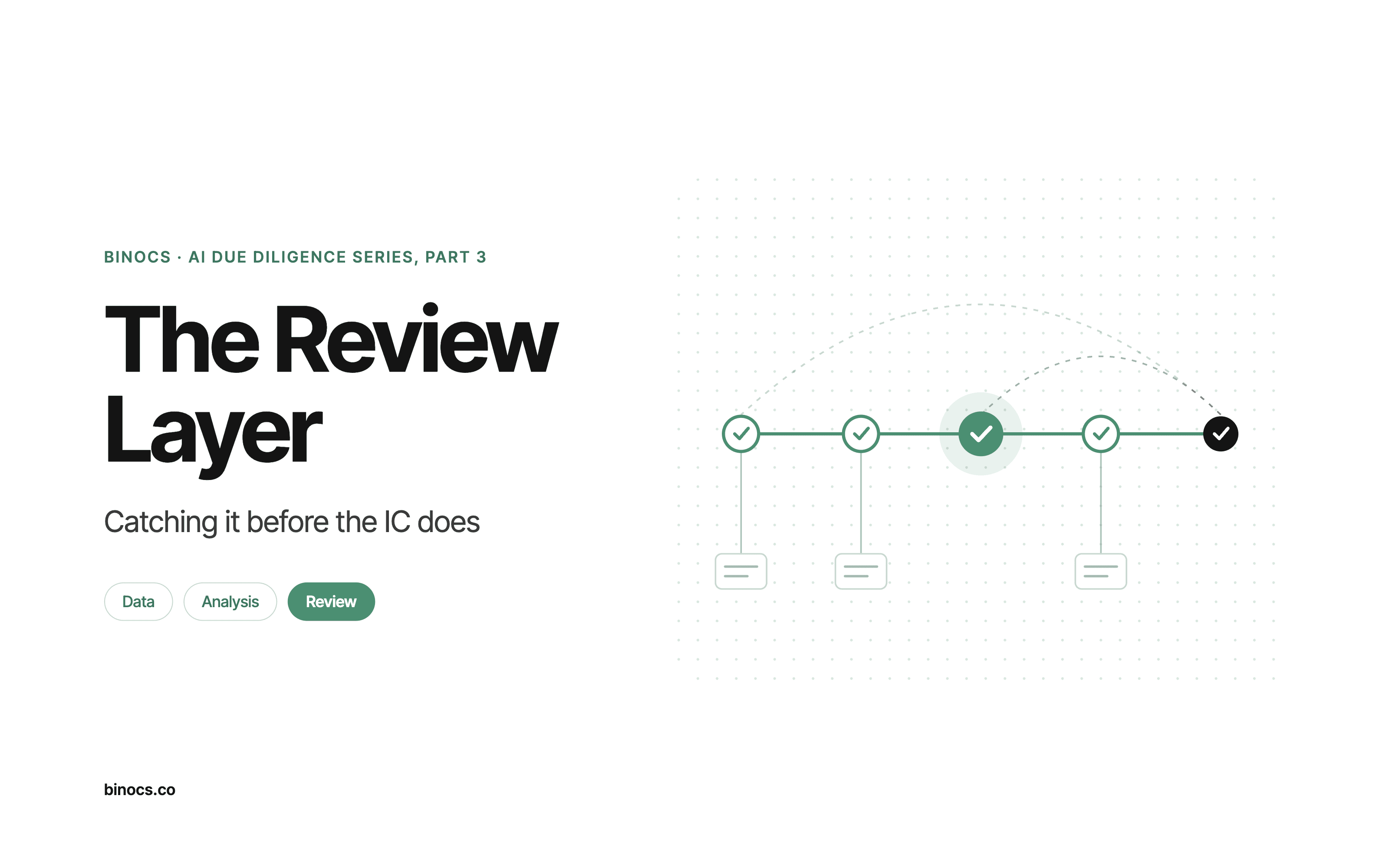
The first two pieces in this series covered how Binocs gathers evidence (the data layer) and how it turns that evidence into analysis (the analysis layer). This piece is about the third layer, review. Its job is to ask, at each checkpoint, whether what the system just produced is right before anything else gets built on top of it.
Our position is that a correct final number is a low bar for AI diligence. An investment committee will ask how the number was reached, which assumptions carried it, and what happens if one of them is wrong. A deal team can only answer those questions if errors were caught where they started, the reasoning is preserved, and the team has a practical way to push back. The review layer is designed around those three needs.
Where errors enter an AI diligence workflow
Most AI errors in diligence are not dramatic hallucinations. They are quieter. A figure is pulled for the wrong fiscal year. A growth rate is applied to a revenue base that already includes an acquisition. A competitor's pricing from a single regional press release gets treated as the market norm. Each is a small slip, and each one is easy to miss when you only see the finished report.
These errors tend to fall into three groups:
- Facts: a number, date or entity that doesn't match its source, or a source that doesn't say what the output claims it says.
- Calculations: arithmetic that is right on its own terms but uses the wrong inputs, units or periods..
- Assumptions and conclusions: a reasonable-sounding leap that the evidence doesn't actually support, or a conclusion that ignores contradicting evidence the data layer already surfaced.
The common fix is a final read at the end, either by a person or by asking the model to check its own work. Both help, but both arrive late. By then, a bad input has already shaped the market sizing, the competitive view and the risk section, and correcting it means unpicking several sections at once. A reviewer who only sees the end product also has to reconstruct how it was made, which is the slowest part of reviewing any analysis, human or AI.
So we moved review earlier and made it continuous.
Three parts of the review layer
Principal Review SLM
The first part is a proprietary small language model whose only job is review. It sits alongside the analysis and checks facts, calculations, assumptions and conclusions at key checkpoints in the workflow, rather than once at the end.
We chose a dedicated reviewer for a practical reason. A model asked to check its own output tends to agree with itself. A separate model trained for review comes to the work with a different brief. Its only task is to find what's wrong. That separation mirrors how a consulting team works, where the associate builds the model and the principal pressure-tests it before it goes anywhere near the partner.
Because the checks happen at checkpoints, an error caught in the market sizing is fixed before it reaches the growth case. That is the main thing this layer buys you. Fewer errors cascade downstream, and the same inputs are more likely to produce the same conclusions from one run to the next.
Diligence-grade traceability
The second part is analytical lineage. Binocs keeps an end-to-end record that links each conclusion to the intermediate analyses, calculations, assumptions and source evidence that produced it.
This is possible because of how the analysis layer works. As we described in the previous piece, Binocs builds its outputs through structured proof-of-work steps rather than a single generation pass. Each step leaves a record. The review layer keeps those records connected, so the path from source to conclusion survives into the final report and can be inspected, validated or challenged.
For a deal team, this changes what review feels like. Instead of asking where a number came from and waiting for someone to reconstruct it, an associate can follow the conclusion back through the calculation to the assumption and then to the page it was drawn from. If a partner disagrees with a conclusion, the conversation can be about the specific assumption they doubt, not about whether to trust the whole report.
Iterative human-guided refinement
The third part puts the deal team's judgment into the loop. Users can critique a report section by section, and Binocs rewrites the parts flagged as weak while keeping the parts that were already strong.
That selectivity matters more than it sounds. Ask a general-purpose model to fix one paragraph and it will often rewrite the whole section, which means re-reviewing work you had already signed off on. Targeted rewrites let feedback build up across iterations. The team's second pass improves on the first instead of starting over, and each round moves the output closer to what a consulting team would hand over.
A worked example: the market that was twice the size
This is an illustrative scenario, not a client engagement.
A mid-market PE firm is looking at a regional commercial HVAC services business. The thesis depends on headroom: the target should be able to keep growing share in a fragmented market without heavy price competition.
Early in the workflow, the data layer surfaces an industry association estimate for the regional HVAC services market. The figure is real and well sourced. The problem is scope. It covers residential and commercial services together, and the target only serves commercial customers.
Without a review checkpoint, that figure flows straight into market sizing. The target's implied share looks roughly half of what it really is, and the growth case reads as if there's far more room to run. Every section after it, from the competitive view to the risk discussion, would be written on top of an inflated market.
At the market sizing checkpoint, the Principal Review SLM compares the scope of the source with the scope of the target and flags the mismatch. The analysis is redone with a commercial-only base, drawing on a second source the data layer had already collected. The growth case that follows is more modest and more honest.
A week later, a partner questions the growth rate assumed for the commercial segment. Because the lineage is preserved, the associate can show exactly which sources the rate came from, how they were weighted, and that one of them was a forecast made several years earlier. The discussion moves straight to whether that older forecast should carry less weight. Nobody has to argue about whether the report as a whole can be trusted.
Finally, the deal team reads the competitive landscape section and finds it too generic for an IC memo. They mark it weak and note what's missing: how the top three regional competitors price maintenance contracts. Binocs rewrites that section with the pricing comparison and leaves the market sizing, growth case and risk sections exactly as the team approved them.
None of these steps are exotic. They are what a careful principal and a good associate would do on a well-run engagement. The difference is that the review layer does the first
round of that work at every checkpoint, so the people's time goes to the judgment calls that need them.
What each part contributes
As with the analysis layer, we look at each component against three outcomes: deeper insights, output consistency and stronger evidence. The review layer leans hardest on the last two. Its main contribution is making outputs more reliable and easier to defend. Insight depth comes mostly from the analysis layer, and review protects it.
If you're evaluating any AI diligence tool, Binocs included, these are the questions we'd ask about its review process:
- Is the output checked during the workflow, or only at the end?
- Is the reviewer separate from the system that produced the work?
- Can you trace a conclusion back through the calculation and assumption to the source page?
- When you flag one section as weak, does the system fix that section and leave the rest alone?
- Will the same inputs give you the same conclusions next week?
A tool that can't answer these clearly is asking the deal team to do the review from scratch, which removes much of the time it was meant to save.
What changes for the deal team
The three layers in this series answer three different questions. The data layer asks whether we found the right evidence. The analysis layer asks whether we reasoned about it well. The review layer asks whether the result is right, and whether you can show why.
For a deal team, the last question is the one that comes up in the IC room. In practice, the review layer changes three things about the work:
- Associates spend less time reconstructing how a number was reached and more time testing whether it should be believed.
- Partners can challenge a specific assumption and see its effect, without having to second-guess the whole report.
- Feedback compounds. Each round of critique improves the parts that needed it and leaves the approved work alone.
AI can now produce a diligence report quickly. Speed was never the hard part of diligence, though. The hard part is producing work a sponsor is willing to stand behind when the questions get specific, and that depends far more on how the work is checked than on how fast it's written.
Frequently asked questions
What is the review layer in AI due diligence?
It's the part of the system that checks the work as it's produced. In Binocs, it reviews facts, calculations, assumptions and conclusions at key checkpoints, keeps the reasoning behind each conclusion traceable, and lets the deal team critique and refine the report section by section.
What is the Principal Review SLM?
It's a proprietary small language model that Binocs uses only for review. It works alongside the analysis and checks the output at checkpoints during the workflow, so errors are caught before later sections are built on them.
Why use a separate model for review instead of having the AI check its own work?
A model reviewing its own output tends to agree with itself. A separate reviewer has one task, which is to find what's wrong. It's the same reason consulting teams have a principal pressure-test the associate's model before it reaches the partner.
If I flag one section as weak, will Binocs rewrite the whole report?
No. Refinement is selective. Binocs rewrites the parts you flag and keeps the sections you've already approved, so feedback builds up across iterations and you don't have to re-review work you've signed off on.
How does the review layer relate to the data and analysis layers?
The data layer finds and validates the evidence. The analysis layer reasons over it through structured proof-of-work steps. The review layer checks those steps as they happen and preserves them, which is what makes the final output traceable.